
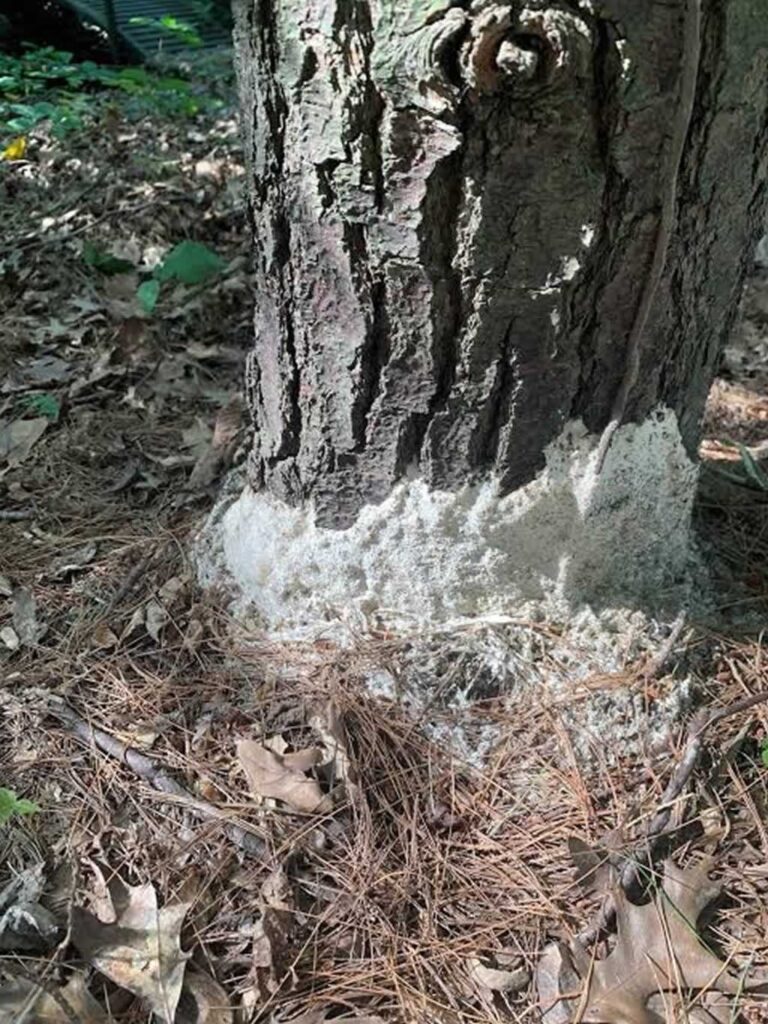
You finally have a free Saturday to tackle the backyard. The patio needs washing, the fence could use a good scrub, and there’s a strange white coating spreading across the trunk of your favorite shade tree.
It looks like mold. Maybe you’ve noticed it before, but now there’s more of it. Since the pressure washer is already out, cleaning the trunk seems like one more job you can cross off the list.
Except a tree isn’t a concrete walkway or wooden fence. Its outer bark protects living tissues beneath it, and blasting away an unfamiliar growth could cause more trouble than leaving it alone.
The white patches might be harmless lichen. They could also be associated with fungi that cause wood decay. Before you pick up a cleaning tool, it helps to know what you’re looking at and which signs actually deserve attention.
The White Stuff on Your Tree Might Not Be Mold at All
White growth on bark is easy to mistake for household mold, especially when it appears after wet weather. But several unrelated organisms can give a tree that pale, dusty, or crusted appearance.
A flat, irregular crust, a cluster of small waxy bumps, and a shelf growing out of wood are different clues. Distinguishing them helps you decide whether to observe, seek insect identification, or request an assessment for decay.
Lichen Can Cover Tree Bark Without Damaging the Tree
Lichen is one of the most common explanations for white, gray, or pale green patches on trunks and branches. It’s a partnership between a fungus and a photosynthetic organism, usually an alga or cyanobacterium.
Unlike a parasitic fungus, lichen doesn’t take nutrients from the tree. It uses the bark as a place to grow. Some lichens form flat, paint-like patches. Others look leafy, wrinkled, or slightly raised. They may become more noticeable during damp weather and can cover surprisingly large areas.
According to the University of Minnesota Extension, lichens don’t harm trees or shrubs and don’t require removal. Lichen doesn’t prove a tree is healthy. When a canopy thins, more light can reach the bark and make lichens conspicuous. Look at the tree’s overall condition rather than treating lichen as a diagnosis.
White Fungus That Grows Into Wood Is a Different Problem
Some fungi do more than settle on the surface. Wood-decay fungi break down structural components inside trunks, branches, or roots.
You might notice a shelf-shaped growth emerging from an old pruning wound or near the bottom of the trunk. These structures, sometimes called conks, can indicate decay inside the wood.
A mushroom in lawn soil and a conk attached to the trunk are not equivalent clues. Even when a conk indicates decay, the amount and location of damaged wood, the tree’s condition, and what it could strike determine the concern. A conk attached to the trunk deserves assessment; washing it off cannot repair the underlying wood.
Powdery Growth on Leaves Isn’t the Same as Growth on Bark
Location offers another clue. Powdery mildew commonly produces white or gray patches on leaves, green stems, and young shoots. It isn’t the same problem as lichen growing on mature bark or fungi decaying the trunk.
University of Minnesota Extension notes that powdery mildew usually causes little damage to established trees and often needs no treatment. The response still depends on the plant and severity of infection.
Before deciding what to do, establish whether the unusual coating is growing on leaves, bark, exposed wood, or soil around the roots. Those are different situations requiring different assessments.
Why a Pressure Washer or Scraper Can Make Things Worse
Bark isn’t a hard surface that can be safely pressure-washed. Removing a surface coating may injure bark while leaving a harmless lichen, an insect problem, or internal decay unaddressed.
Harmless Lichen Doesn’t Need to Be Scrubbed Away
When the growth is harmless lichen, removing it offers no tree-health benefit. The Royal Horticultural Society warns that brushing or pressure washing lichens and other surface growths from trees can damage bark and branches.
Even if you manage to remove the visible coating, it may return because the surrounding conditions haven’t changed. Focus on the tree’s overall condition.
Damaging the Bark Can Leave the Tree More Vulnerable
Outer bark shields living inner bark and underlying wood from injury and exposure. Inner bark carries sugars from the leaves; water moves mainly through the sapwood beneath it.
A concentrated pressure-washer jet can damage bark, particularly on young trees or species with thinner bark. Aggressive scraping, wire brushes, and sharp tools present similar risks.
Trees do not heal wounds like human skin. Instead, they grow new tissue around injuries and compartmentalize damaged wood, limiting but not necessarily stopping decay.
Penn State Extension explains that decay fungi can enter through wounds and that trees form internal barriers to slow their spread. Avoid turning a harmless surface growth into an unnecessary injury.
Fungicides Won’t Repair Wood That’s Already Decaying
If you’re trying to understand what’s happening, the useful starting point is the type of growth and the condition of the surrounding bark, branches, and roots. Those details help you determine whether white fungus growing on trees is harmless surface growth or a sign of a possible structural problem.
Those details help distinguish something that needs no treatment from a possible structural problem. Fungicides cannot restore strength to wood that has already decayed. Household bleach and other cleaning chemicals are no substitute for identifying the cause, and applying them unnecessarily may damage
s or surrounding vegetation.
Look at the Bark Before You Try to Remove Anything
You don’t need to climb a ladder or cut into a tree to make a useful initial observation. Start from the ground in good daylight. Examine the shape and location of the growth, then look for other changes in the trunk and canopy.
Flat White Patches That Sit on the Surface
Lichen often forms distinct patches that appear attached to the outer bark. The patches may have irregular edges and vary from chalky white to gray-green. A trunk covered in these markings can look alarming even when the tree is growing normally. Small, regularly shaped white bumps may instead be scale insects.
University of Maryland Extension notes that scale covers tend to be rounded or oyster-shell-shaped, unlike larger, irregular lichen patches. Some soft scales also leave sticky honeydew on nearby leaves, although armored scales do not. Don’t scrape bark to test the difference.
Look at nearby branches and leaves. Is the canopy reasonably full for the species and season? Are there obvious dead limbs or unusual wounds? These are clues, not proof that the wood inside is sound.
Shelf-Like Growths Near Old Cuts and Damaged Bark
An old branch stub, storm wound, or damaged section of bark can create an entry point for decay organisms. If a firm, shelf-like fungal structure appears at one of these locations, don’t assume it’s something you can scrub away.
Photograph it from a safe position. Include a close-up of the attachment point and a wider view showing whether it is on a major branch, the trunk, or near the roots.
Avoid pulling it off to inspect the surface underneath. Removing a fruiting body can destroy features useful for identification without removing the fungus inside the wood.
Crumbling Wood, Dead Branches, and Other Changes Worth Noting
White patches deserve closer attention when they appear alongside additional symptoms. Look for exposed, deteriorating wood, large cavities, significant cracks, or unexpectedly dead branches. Newly lifted soil or movement around the root plate can also signal a serious stability concern.
A tree may naturally shed portions of its outer bark, and some species develop deeply fissured trunks as they mature. What matters is whether there’s an unusual change, particularly around an existing wound or fungal growth.
If the trunk has obvious structural damage, keep people away from the surrounding area until a qualified arborist can assess it.
Check What’s Happening Around the Base of the Tree
Look for the root flare, where the trunk broadens toward the roots. It is normally visible on many trees; inspect without digging into the soil. Root problems can remain hidden until symptoms develop aboveground.
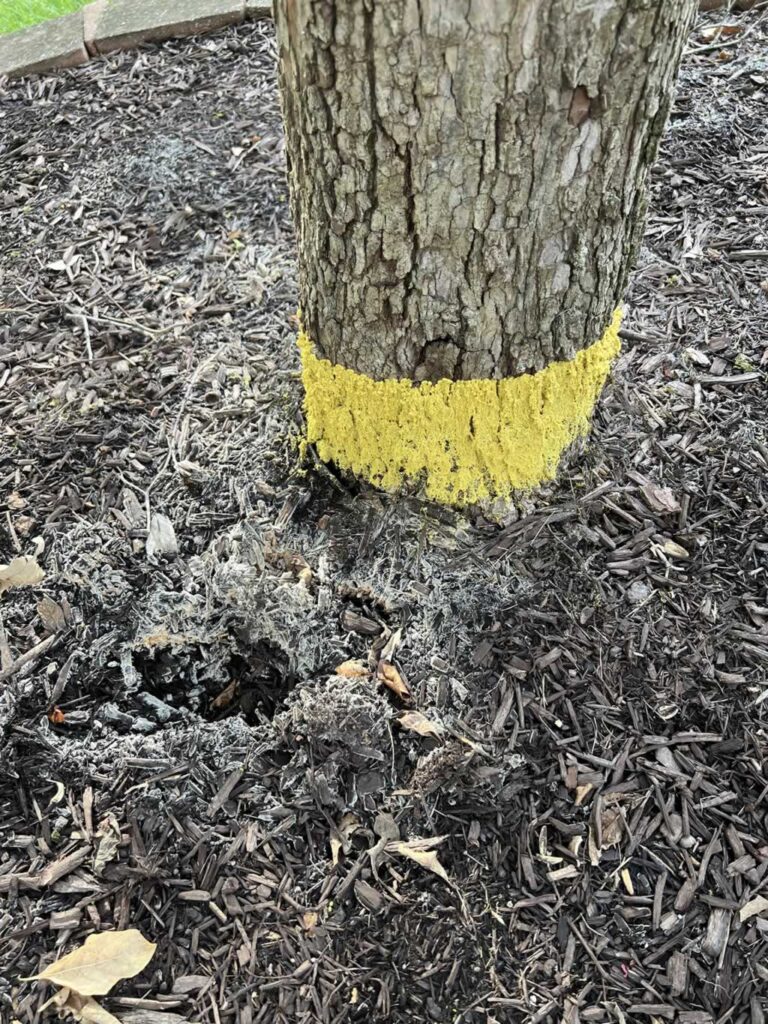
Mulch Piled Against the Trunk and Persistently Wet Soil
A mound of mulch against the trunk can hold moisture against bark. Persistently wet bark and poorly drained soil may favor disease or add stress, but neither condition by itself proves that the tree has a decay infection.
University of Minnesota Extension advises using a shallow layer of mulch and leaving a clear gap around the trunk. Check whether repeated mulching has covered the root flare, and gently pull surface mulch away from the trunk if needed. Also note pooling irrigation water or poorly draining soil.
Do not excavate soil around buried roots yourself. Correcting these conditions may help prevent additional stress, although it won’t reverse an established fungal infection.
Root Damage From Lawn Equipment and Landscaping Work
Landscaping can injure trees without leaving obvious trunk damage. String trimmers can damage bark around the base. Excavation may cut important roots, while machinery and repeated foot traffic can compact the surrounding soil.
Soil compaction can restrict the movement of air and water around roots, even when no trunk damage is visible.
If the white growth appeared after construction or major yard work, mention that history during any professional assessment. Previous root disturbance can be an important part of understanding a tree’s condition.
Mushrooms Growing Around the Trunk or Exposed Roots
Mushrooms in ordinary lawn soil aren’t automatically a sign of trouble. Many fungi feed on buried leaves, old mulch, or other decomposing organic material. Mushrooms emerging directly from the base of a living tree, attached roots, or exposed woody tissue deserve a different level of attention.
Certain root-decay fungi produce mushrooms near infected trees. Others form shelf-like structures around the lower trunk.
Appearance alone won’t tell you how much structural support remains. If these growths are close to a house, driveway, or regularly used seating area, arrange a qualified assessment rather than digging around the roots to investigate.
A Few Things You Can Safely Check From the Ground
Not every unusual patch requires immediate treatment. When there are no obvious structural warning signs, a simple observation routine can help you understand whether something is changing.
Photograph the White Patches and Watch for Changes
Photograph the growth and the whole tree. Take one close-up that shows texture, ideally with a ruler nearby for scale, and a wider view of the whole tree. Repeat the wider photo from the same position to help compare changes over time.
Record roughly when you first noticed the patches, whether they’ve changed, and whether there were recent storms, construction projects, or unusual watering conditions.
Don’t wait for a visible patch to spread if the tree already has serious cracks, extensive dieback, or an unstable lean. Those symptoms warrant prompt attention.
Compare the Tree’s Leaves, Branches, and Overall Growth
Compare the tree’s current growth with its usual seasonal pattern. A full canopy and typical new growth are reassuring, but they do not rule out internal decay. Watch for major branches that fail to leaf out, unexpected thinning, unusually small foliage, or substantial dieback.
Compare the tree with earlier photographs from the same season if available. Normal autumn leaf drop on a deciduous tree is different from unexpected thinning during its growing season.
If the growth is hard to identify, a local Cooperative Extension office may be able to review clear photographs. If branches, trunk, or roots show structural warning signs, contact an arborist instead.
Correct Basic Moisture and Mulching Problems Without Disturbing the Roots
Correct moisture and root-zone conditions without disturbing the growth. Keep sprinklers from repeatedly soaking the trunk, and adjust watering to soil conditions and recent rainfall. Protect the root zone from unnecessary digging and equipment traffic.
Avoid excavating around the base to look for fungus, pulling off attached bark, or drilling into the trunk. Those actions can create additional injuries and may make a professional diagnosis more difficult.
When the White Growth Becomes a Reason to Call an Arborist
Some tree problems are best evaluated by someone trained to assess tree health and structural condition. The location of a defect matters as much as the growth itself. A suspected decay area on a major limb or at the roots needs more attention when failure could strike people, vehicles, or buildings.
Fungal Growth Appearing Alongside Wood Decay
A small lichen patch on intact bark is usually a reason to observe, not to clean. Clusters of uniform waxy bumps suggest checking for scale insects. By contrast, conks attached to woody tissue, mushrooms emerging from woody roots, cavities, major cracks, a new lean, or large dead branches warrant an arborist’s assessment. The International Society of Arboriculture identifies fungal fruiting bodies, cavities, and dead limbs as potential warning signs.
If a concerning growth appears on a tree near a house, sidewalk, or other occupied area, arrange a qualified arborist’s assessment. If the tree develops a severe crack, suddenly shifts or leans, or shows another sign of imminent failure, keep people away from the possible fall area and seek urgent help.
An ISA Certified Arborist can evaluate the tree and discuss next steps. For suspected structural hazards, ask whether the professional has tree-risk training, such as the International Society of Arboriculture’s Tree Risk Assessment Qualification.
The International Society of Arboriculture’s Find an Arborist directory helps you locate or verify credentialed professionals. Do not climb, excavate around roots, or remove fungal structures while arranging an assessment.