

Looking for a way to create more space in your home without building an extension or using a contractor? Then perhaps a partition wall is the way to go, as it allows you to use the space in your home more effectively. A partition wall is in essence a wall that separates or divides a room. It is not a load-bearing wall and therefore can be made of almost any material. This guide will focus on building a partition wall with lumber studs as this is the easiest and most affordable way.
If you’re wondering how to build a wall partition, this guide walks you through every decision and every step, from choosing your framing method to sanding the final coat smooth. A room that’s too open, too noisy, or carved into dead space costs you every single day. Whether you’re splitting a large bedroom to create a home office, carving a private nursery out of an open-plan area, or adding a rental-ready suite to your basement, building a wall partition is one of the highest-ROI home improvement projects you can tackle yourself. At Handyman Tips, we’ve walked thousands of homeowners through this exact build, and the pattern is always the same: the project feels intimidating before you start and straightforward the moment you understand the sequence.
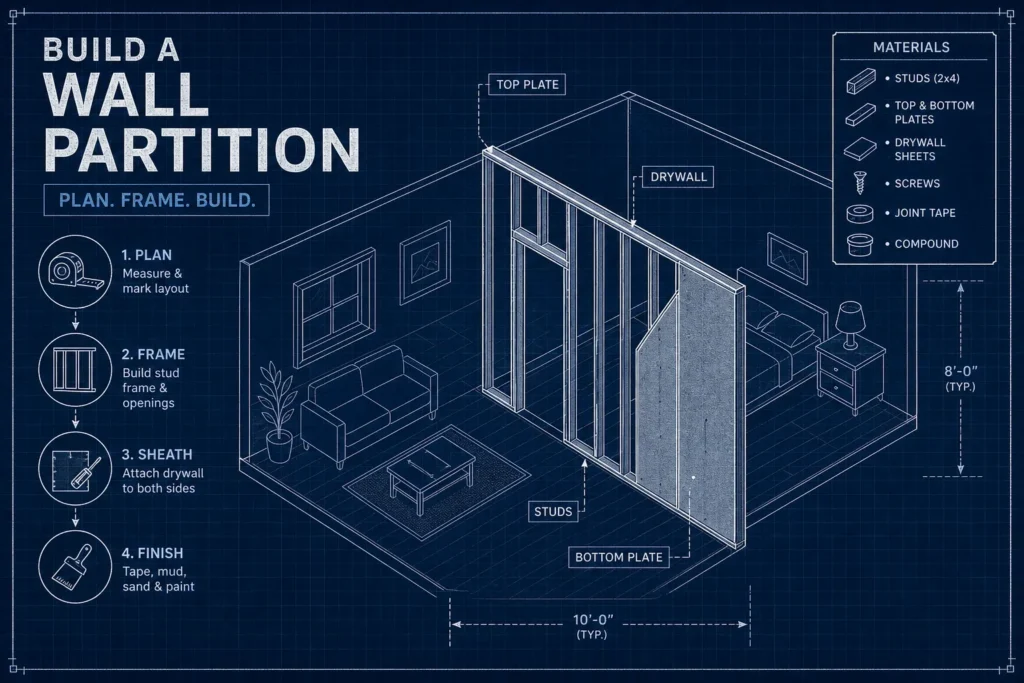
There are three main routes: a temporary divider using curtains or folding panels, a timber-stud drywall partition, or a metal-stud drywall partition. This guide gives you a clear decision framework, a complete materials list, a step-by-step build sequence, and realistic cost benchmarks, so you can choose the right method and start with confidence.
1. Choose your partition type before you spend a dollar
Picking the wrong method doesn’t just waste money, it means tearing things out and starting over. Run through the three options below before you buy a single board or stud.
Timber stud vs. metal stud: the real tradeoffs
Metal studs are dimensionally stable, they won’t warp or shrink after installation, and they’re non-combustible, which makes them the better choice for fire-sensitive areas and commercial-grade builds. The tradeoff is load capacity. Hanging heavy shelves, a wall-mounted TV, or bathroom fixtures on metal studs requires plywood backing or specialty anchors planned in from the start. Timber studs, by contrast, accept conventional screws and nails at any point, making future modifications straightforward. They’re also the more familiar material for most DIYers, and for a simple residential partition they’re often cheaper. The main weakness of timber is movement: seasonal shrinkage and swelling cause joint cracks over time, particularly in unheated or high-humidity spaces.
When a temporary room divider is the smarter call
If you’re renting, staging a home for sale, or just testing a layout, don’t build a permanent wall. Curtain tracks, folding screens, and modular panel systems can divide a room in under six hours for $50 to $400 total. The honest limitations are real: minimal soundproofing, no fire separation, and no permanence. These options work well for renters and short-term situations. They’re a poor fit for anyone who needs privacy, noise control, or a wall that can carry anything.
Cost and time snapshot by method
Here’s the quick comparison so you can self-select before ordering materials.
| Method | Material cost (DIY) | Build time | Best for |
| Temporary divider (curtain, screen, panels) | $50, $400 | Under 6 hours | Renters, staging, budget-first |
| Timber stud + drywall | $350, $700 | 1, 3 days | Permanent walls, heavy fixtures |
| Metal stud + drywall | $350, $700+ | 1, 3 days | Fire-rated, straight, low-maintenance |
A door opening, cavity insulation, or new electrical outlet adds $0.50 to $1.00 per square foot for insulation and half a day to a full day for door framing. Factor those in before you finalize your budget.
2. Tools and materials for a standard partition wall
The shopping list below is based on a 12-foot-long by 8-foot-high non-load-bearing wall with no door opening. Adjust quantities for your actual dimensions.
Framing materials (quantities for a 12-ft wall)
- 2x4x12-ft lumber: 2 pieces for the top and bottom plates
- 2x4x8-ft precut studs: 11 pieces (10 at 16-inch centers, 1 end stud)
- Wood shims: 1 pack
- Construction adhesive: 1 tube (optional but recommended under the bottom plate)
If you’re adding a door, budget for two king studs, two jack studs, a header, and short cripple studs above the opening. That’s at minimum four extra stud lengths plus header lumber.
Drywall, fasteners, and finishing supplies
A 12×8-ft wall has 96 square feet per face, so both faces total 192 square feet. Six sheets of 1/2-inch gypsum board (4×8, 32 sq. ft. each) covers both sides with nothing to spare, so buy a seventh sheet as a buffer. You’ll also need one roll of paper joint tape (250 ft.), one 3.5 to 4.5-gallon bucket of premixed joint compound, one gallon of drywall primer, and roughly two gallons of interior paint. Upgrade to moisture-resistant board for bathrooms or laundry rooms, and to 5/8-inch Type X for any wall requiring a fire rating. For fasteners, one box of 1,000 fine-thread 1-1/4-inch drywall screws covers the job with plenty left over, plus 40 to 50 framing screws for the plate and stud assembly.
Tool checklist
- Tape measure, chalk line, pencil, speed square
- 4-ft level or laser level, stud finder, plumb bob
- Utility knife, drywall saw, circular saw or miter saw
- Drill/driver, drywall screw gun
- Mud pan, 6-inch and 10 to 12-inch drywall knives, sanding sponge
- Safety glasses, dust mask, hearing protection, work gloves
3. How to Build a Wall Partition: Measure, Mark, and Frame
Framing errors compound. A plate that’s half an inch out of plumb produces a drywall gap that requires extra compound, a visible ridge, and extra finishing time. Get the layout right before you drive the first screw.

Laying out the wall line and transferring it to the ceiling
Snap a chalk line on the floor exactly where you want the face of the wall. Use a laser level or plumb bob to transfer that line vertically to the adjoining walls and up to the ceiling. Mark door openings and any service zones (plumbing drops, electrical conduit paths) before you go further. Verify that the floor and ceiling marks are directly aligned, a misaligned top plate creates a wall that leans and is nearly impossible to correct after drywall goes up.
Installing plates and studs step by step
- Check beneath the bottom plate line for hidden pipes, electrical cables, or radiant heating before fastening anything.
- Fasten the bottom plate to the subfloor using 3-inch structural screws for wood or concrete screws for a slab, spaced every 16 inches.
- Fasten the top plate directly into ceiling joists or pre-installed blocking. Never rely on ceiling drywall to hold the plate.
- Insert studs at 16-inch on-center spacing, checking each one for plumb, with all faces oriented consistently.
Framing a door opening the right way
The rough opening for a standard interior door is the nominal door width plus 2 to 3 inches and the door height plus 2 to 2-1/2 inches. Install full-height king studs at each side of the opening first, then jack studs running up to the underside of the header. The header spans between the jack studs and transfers load (or in a non-load-bearing wall, just keeps the framing square) to the king studs. Fill in short cripple studs above the header at normal stud spacing. For metal-stud partitions, use doubled or heavier-gauge studs at door edges and a boxed-track header rather than dimensional lumber. If the plan includes a sliding partition door, rough in extra width on both sides of the opening to accommodate the pocket or barn-door hardware.

4. Insulation, soundproofing, and rough-in electrical
Everything that goes inside the wall cavity happens before you close the second face of drywall. Skipping this step means cutting open finished walls later.
Which insulation actually improves sound control
A basic single-layer drywall wall with an empty cavity sits at around STC 33 to 35, normal conversation is easily audible through it. Adding mineral wool batts and a second layer of 5/8-inch drywall pushes that to roughly STC 43 to 50, an improvement of 8 to 15 points that makes a real difference in day-to-day livability. Fiberglass batts work but add less mass and absorption than mineral wool. The cost premium for mineral wool runs roughly $0.50 to $1.00 per square foot, which is almost always worth paying for a bedroom or home office partition.
Running wires and pipes before you close the wall
Route electrical cables through aligned stud knockouts and fit plastic bushings or grommets wherever cable touches a metal edge. Install nail plates over cable paths within 1-1/4 inches of the stud face so drywall screws can’t reach the wire. Avoid placing electrical boxes back-to-back on opposite stud faces, that single mistake punches a sound path straight through an otherwise solid wall. Pressure-test any new plumbing before boarding up, and seal every penetration through a fire-rated wall with listed firestop material, not standard joint compound or foam.
When to bring in a licensed electrician
Adding one outlet to an existing circuit is usually within DIY territory with the right permit. The moment the work involves a new circuit breaker, subpanel connection, permit-required inspection, or anything beyond a straightforward outlet or switch, bring in a licensed electrician. The inspection risk alone makes professional help the smarter financial call at that point.
5. How to Build a Wall Partition: Hang Drywall and Finish to Paint-Ready
Hanging drywall on the first face is satisfying work. Finishing it to a paint-ready surface is where patience separates a professional-looking result from an obvious patch job.
Hanging and fastening gypsum board correctly
Start with full sheets, keeping cut edges at corners or less visible locations. Lift each sheet slightly off the floor to prevent moisture wicking, and drive screws just below the paper face without breaking it. Space screws approximately 8 inches apart at board edges and 12 inches apart in the field. When you close the second face, stagger those joints relative to the first side so no continuous seam runs through the wall.
Taping, mudding, and sanding without the mess
The process runs in three coats. Coat 1 embeds paper tape in wet compound and covers all screw heads. Coat 2 feathers wider, typically 8 to 10 inches across the joint. Coat 3, where needed, smooths and extends the feather. Install metal corner bead on every exposed outside corner and coat both sides in the same sequence. Sand with a work light raked across the surface at a low angle, it reveals every ridge, low spot, and screw pop that you’ll otherwise miss until primer goes on.
Priming, painting, and decorative finish options
Drywall primer equalizes the different porosity between the paper face and the joint compound before paint goes on. Skip it and you’ll see flashing (dull spots over the compound) through even two coats of paint. Two coats of interior paint complete a standard finish. For a modern open look, consider framing a glass insert for borrowed light between rooms, or adding wood trim and paneling to warm up the surface and tie the new wall into existing millwork.
6. Troubleshooting common partition wall problems
Even a well-executed partition can develop issues over time. Most of them are fixable without tearing out drywall.
Fixing bowed studs, joint cracks, and screw pops
A bowed timber stud can often be corrected by sistering a straight stud alongside it and pulling them together with screws. Joint cracks from wood movement need the cracked compound removed, the joint re-taped with fresh compound, and a flexible joint compound on the finish coats. Screw pops are fixed by driving a new screw one inch above or below the popped fastener, then covering both heads with feathered compound.
Soundproofing gaps that kill performance
The most common sound leak points are electrical outlets (use acoustic putty pads around boxes), ceiling cavity gaps above the top plate (pack mineral wool up there), and unsealed perimeter joints where the wall meets the floor, ceiling, and adjoining walls. Acoustic sealant, not standard painter’s caulk, belongs in those joints. Plugging these gaps costs almost nothing but can recover several STC points on an otherwise well-built wall.
Permits, load-bearing checks, and when to hire a pro
Most U.S. jurisdictions require a permit any time a new wall includes electrical work, creates a new bedroom, or affects egress and fire-rated construction. A plain non-load-bearing partition with no utilities may be exempt depending on your municipality, but call your local building department and describe the project specifically before assuming you’re in the clear.
To check whether a wall is load-bearing, look at whether it runs perpendicular to the floor joists and whether there’s a beam directly above it. If there’s any doubt, get a structural engineer’s opinion before proceeding. Complex electrical, fire-separation requirements, or multi-trade coordination are the three scenarios where hiring a licensed contractor is the right call, not a defeat.
Frequently asked questions about building a wall partition
How do I know if I need a permit to build a wall partition?
Permit requirements vary by municipality. In most U.S. jurisdictions, you’ll need one if the new wall includes electrical work, creates a habitable bedroom, or affects fire-rated or egress construction. Call your local building department and describe the project before you start, it’s a five-minute conversation that can save significant headaches later.
How do I build a wall partition in a bedroom?
A bedroom partition follows the same framing sequence as any non-load-bearing wall: snap your layout lines, install top and bottom plates, set studs at 16-inch centers, insulate for sound, and close with drywall. The key bedroom-specific considerations are egress (the new room may require a window), smoke detector placement, and whether a closet or door needs to be incorporated into the framing plan.
What’s the difference between a gypsum board partition and a standard drywall partition?
None, gypsum board is simply another name for drywall. Both terms refer to the same panel product: a gypsum plaster core sandwiched between paper facings. “Gypsum board partition” is the term more commonly used in commercial construction specs, while “drywall partition” is standard in residential contexts.
Can I build a wall partition without professional help?
Yes, for a standard non-load-bearing partition wall. The framing, drywall hanging, and finishing are all achievable for a competent DIYer following a clear sequence. Bring in a licensed electrician for any new circuits or panel work, and consult a structural engineer if you’re unsure whether a wall is load-bearing.
How long does it take to build a wall partition?
A straightforward framed drywall partition takes 1 to 3 days for a DIYer working alone. That includes framing, insulating, hanging drywall on both faces, and the first mud coat. Taping and finishing add another 2 to 3 days once each coat dries fully, rushing the drying time is the most common cause of cracking and poor results.
Conclusion
Building a wall partition is one of the most achievable DIY home improvement projects when you follow the right sequence: choose your method, gather materials, frame the wall, insulate and run services, close the drywall, and finish to paint-ready. The cost range runs from $50 for a temporary room divider to $700 or more in materials for a permanent framed drywall partition, with the vast middle ground sitting comfortably between $350 and $500 for a straightforward bedroom or office split.
Knowing how to build a wall partition properly, rather than just winging it, is what separates a wall that lasts from one you’re patching every spring. Plan the framing before you buy lumber, insulate before you close the cavity, and prime before you paint. Each step is logical when you know what comes next.


Hello sir, it’s my first pay a quick visit to this.
Actually, you are a skilled man. It is surprising to me that you have made this issue so beautiful on your blog. I wish I could spend time on your blog so that I can learn. And I hope that we can read such good Article in the next day.