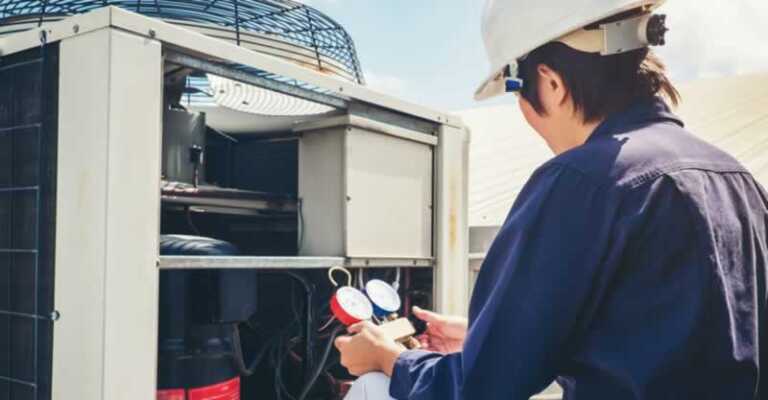
Having an Ac unit has become a necessity nowadays, with weather conditions and other factors. Winters are becoming colder, and summers are becoming unbearably hot. In such cases, the best way to survive is to regulate your house temperature with an AC unit. Nowadays, most AC units can control the temperature in both winter and summer. If you get used to your AC, you probably know how bad it feels when your AC unit suddenly stops working. It could be the middle of summer, and you’ll be stuck in the sweltering heat, not knowing what to do.

Fortunately, there are ways to restart your AC in such situations without calling a technician. However, you have to take precautions and make sure you don’t remove any component without the proper technical expertise.
Here are some things you can do when your AC unit stops working:
1. Check the thermostat settings.
In many cases, the simplest of problems causes the AC unit to stop working. It could be that the thermostat settings are entirely wrong. Sometimes you may have put the settings on heating instead of cooling, which could cause problems with the AC. In such cases, the best thing to do is to reset the AC. Make sure it is on cooling instead of heating. Another way around this is to make sure that the AC settings are on auto. You’ll be surprised at how common it is for people to call a technician when the problem could be fixed by adjusting the thermostat’s function. In very few cases, it could be that the batteries of the thermostat are finished. It’s always better to double-check just in case.
2. Check the air filter.
One of the most common causes of a malfunctioning air conditioner is a dirty air filter. While your technician will usually clean the air filter when doing a service, it might still get dirty. This is especially true if you are living in an area where there is a lot of pollution. If the AC turns on, but there is no cooling, you should check the air filter. If it is clogged up and you can’t see through it, then that’s probably the cause. Simply remove the filter and clean it until it becomes transparent. Add the clean filter and try again. If your AC still does not work, then maybe it’s time you call Sutherland Shire ducted air conditioning Company.
3. Adjust the circuit breaker
Sometimes a spike in the power voltage may cause the circuit breaker to trip. This can also happen if the voltage suddenly fluctuates. In such cases, the circuit breaker will turn off to prevent damage to the AC unit. A simple way around this is to check the position of the circuit breaker. Turn it back on and try again. If you turn on the circuit breaker, you still don’t respond; you should check the main electricity supply. Sometimes, there might be an issue with the mains. It could be because of a voltage fluctuation or an earth leakage. Simply turn the power back on and check if the AC starts working.
4. The fuse is damaged
Sometimes, the problem could be caused by a blown fuse rather than an external issue. Just as with other appliances, most AC units will stop working if the fuse is blown. In such cases, you should consider replacing the fuse before you can start the AC. While you could do this yourself, it is quite tricky and requires technical expertise. Have a professional HVAC company replace the fuse to prevent damage to other parts of the AC. They may also be able to diagnose why the fuse got damaged in the first place.

5. The AC coils are damaged.
If your AC doesn’t start properly, then it could be because of a damaged coil. This can be caused by pests, pollution, or dirt that blocks the air vents. If the air vents are entirely clogged, it can cause hot air to circulate through your home, and the AC won’t work effectively. One way to make sure that this doesn’t happen is to service your HVAC regularly. The technician will check the vents and clear any dirt that could be blocking them.
6. The core components are damaged.
If you have an older AC unit, you may have to replace specific components of your AC unit. This is usually an issue with the capacitors as they deteriorate over time. It could also be that your unit was damaged because of an accident or other cause. In such cases, you may have to diagnose the AC properly through an HVAC professional. They will identify the exact problem and tell you which parts you need to replace. Unless you have technical expertise, you should not attempt to replace any parts by yourself.
7. Nothing is wrong with your AC
Sometimes, there is nothing wrong with your AC unit. You may not believe this, but it could be fixed by simply restarting the AC!
Has it serviced regularly?
Preventing such issues from happening in the first place is much better. If you want your AC to work properly when you need it, make sure you regularly service it. Have the air filters cleaned and check the gas pressure in the pipes. In many cases, a simple test can detect a significant problem before it happens. Small leaks can be detected during regular service, and patching up these leaks will save you a lot later on. If your warranty is expired, then you should service it more regularly because the cost of replacing certain parts will increase drastically.
Use it in the right way.
One way to prevent damage to your AC unit is to use it correctly. Try and set the temperature at around 25 degrees Celsius and not less than 2Ensureure that the AC unit is suited to the rooms’ size so that the cooling is at an optimal level. Taking small precautions will decrease the chances of anything significant happening to your AC.