Screwdriver is invented in the 15th century and through the centuries it became the essential tool in every toolbox. Most people don’t know much about screwdriver types and their uses but that knowledge is essential for success in every project. If we want to do things properly we need to use proper screws and therefore we need to use the appropriate screwdriver as well. Also, for every repair we need to use at least two types of screwdrivers and it’s very important that we learn as much as we can about screwdriver types.

In this article we will cover the most common screwdriver types that are essential in every DIY homeowner toolbox.
Slotted Screwdriver
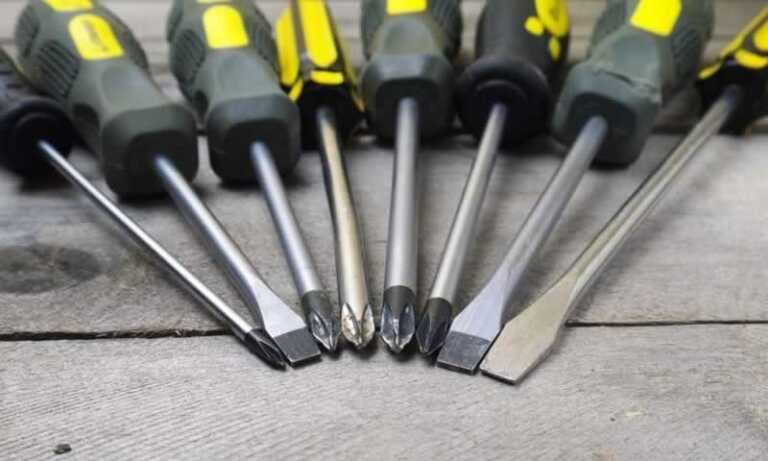
The slotted screwdriver was one of the very first screw heads and it still continues to enjoy some popularity. A simple diagonal slot on the screw head holds the tool blade which is inserted into the slot. Disadvantage is that the bit tends to slip out of the screw and it has sharp edges, making it unsuitable for mechanical applications. With this screwdriver type the force is applied to the diagonally opposite outer edges of the slot. In the last 10-15 years, the slotted screwdriver is losing its popularity among screwdriver types and it’s rarely used anymore.
Phillips Screwdriver
When you look the Phillips screwdriver from the front, the tip of the screwdriver looks like a cross. If you are buying high quality screwdrivers, then the actual tip of the tool will not sharp but rounded. If you want to use screwdrivers with sharp, almost needle-like tips, they will not fit screws made in the US. Our advice is that you don’t buy them unless you are working with screws that match their narrower profile. You will recognize high quality Phillips screws because they’re marked with a number engraved on the head which denotes the size of the drive required. If you want a screwdriver for general DIY purposes, then the #2 Phillips drive is the most commonly used. Phillips screwdriver is available in sizes ranging from 1 to 4 for general purposes and larger sizes are available for industrial applications.

Pozidriv Screwdriver
The Pozidriv screwdriver, unlike Phillips, has two crosses. The Pozidriv screwdriver is a further development of the Phillips screwdriver and it features two crosses offset at 45-degree angles. The additional cross is narrower than the main cross and it’s not as deep. Pozidriv screwdriver offers additional stability and better resistance to slipping. Although the Pozidriv profile offers an improvement compared to the classic Phillips slot profile, it doesn’t overcome the problems inherent in the classic Phillips design, such as the cam-out forces. The cam-out forces can be dealt with a special surface coating on the tool tip and you should look for screwdrivers with coated tip when searching for high quality screwdrivers.
Square recess or Robertson screwdriver
Square recess screwdriver is also called the Robertson screwdriver, after its Canadian inventor. The name itself explains that the drive in these screws is a recessed square. Because there are no angles involved, it’s almost impossible for a driver to slip out of the recess. In that way very high torque values can be applied. It’s even more likely that the screw will snap off before the square-shaped driver will slip out of the drive. The most common sizes of Robertson screwdrivers are #2, and #3 drives. Select the size of the drive carefully and don’t use the #2 drive in a #3 screw, since this will damage the both the screw and the driver. Among screwdriver types, the Robertson screwdriver is very popular in the US but not so common in Europe.

Torx screwdriver
Torx screwdriver has a star-shaped, elliptically-based geometry with six rounded lobes. The Torx screwdriver can be used to transfer a higher torque than the classical screw profiles without damaging bit or screw. Thanks to the low radial forces, the tool life of both screw and driver is prolonged. This low radial forces in Torx screwdriver are a result of the circular geometry of the lobes, the straight, vertical sidewalls and the drive-angle of just 15 degrees and that geometry produces virtually no stress concentration. Unlike Phillips or Pozidriv screwdrivers, for example, the Torx screwdriver doesn’t require the application of force. Much higher torques can also be transferred with Torx screwdriver whilst applying the same amount of force as with Phillips or Pozidriv screwdriver. The special type of Torx screwdriver is Torx Plus, which is an enhanced Torx design that allows more contact area between the driver and the screwhead allowing more torque to be applied, even at high driving speeds.
Hex screwdriver
Hex screwdriver has six even straight sides and that is where it’s name comes from, the hexagon screwdriver. However, most hex drive fasteners are bolts, rather than screws, but there are nevertheless screwdrivers available to drive them. The most common use for hex screwdrivers is in the assembly of furniture, but using a T-handled Allen wrench is often the better choice when working with these screws because it provides for the application of higher torque values than is possible with a narrow-handled screwdriver.
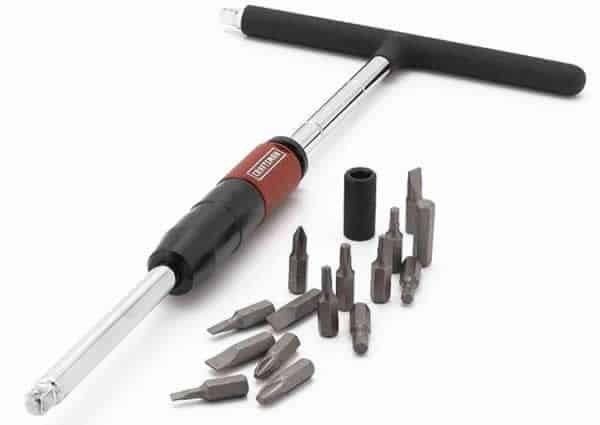
There are many more screwdriver types that aren’t mentioned above but those are highly specialized tools which are used in specific industries. As far as DIY homeowner toolbox is concerned you’ll need only six types explained above. There are still people who prefer classic screwdrivers but the most efficient option is to get yourself a T-handle with bit set which usually covers all screwdriver types explained above. Today those sets aren’t expensive and every homeowner should have one in his toolbox!



classy info from you guys , Interested in learning .please send more information,Thanks